Most health problems at home don't start in a hospital. They start in the kitchen: milk with added water, oil reused for frying five times, leftovers left out overnight, or a 'healthy' snack that is mostly sugar.
Below are 13 simple checks from our Health Awareness Guides, one from each book. Each takes a few minutes, needs nothing you don't already have at home, and makes your family's food a little safer and better.
These tips are general information to help you make better everyday choices. For any health problem, please talk to your doctor.
13 Checks for a Safer, Healthier Kitchen
01
Check your milk for added water in 10 seconds
Milk is one of the most commonly adulterated foods in India, and this check needs only a single drop.
How to do it
- Put a drop of milk on a clean, polished, slanting surface, such as a steel plate held at an angle.
- Pure milk flows slowly and leaves a white trail behind it.
- Milk with added water runs down quickly and leaves little or no trail.
- If it keeps happening, change your supplier and report it to FSSAI on the Food Safety Connect app.

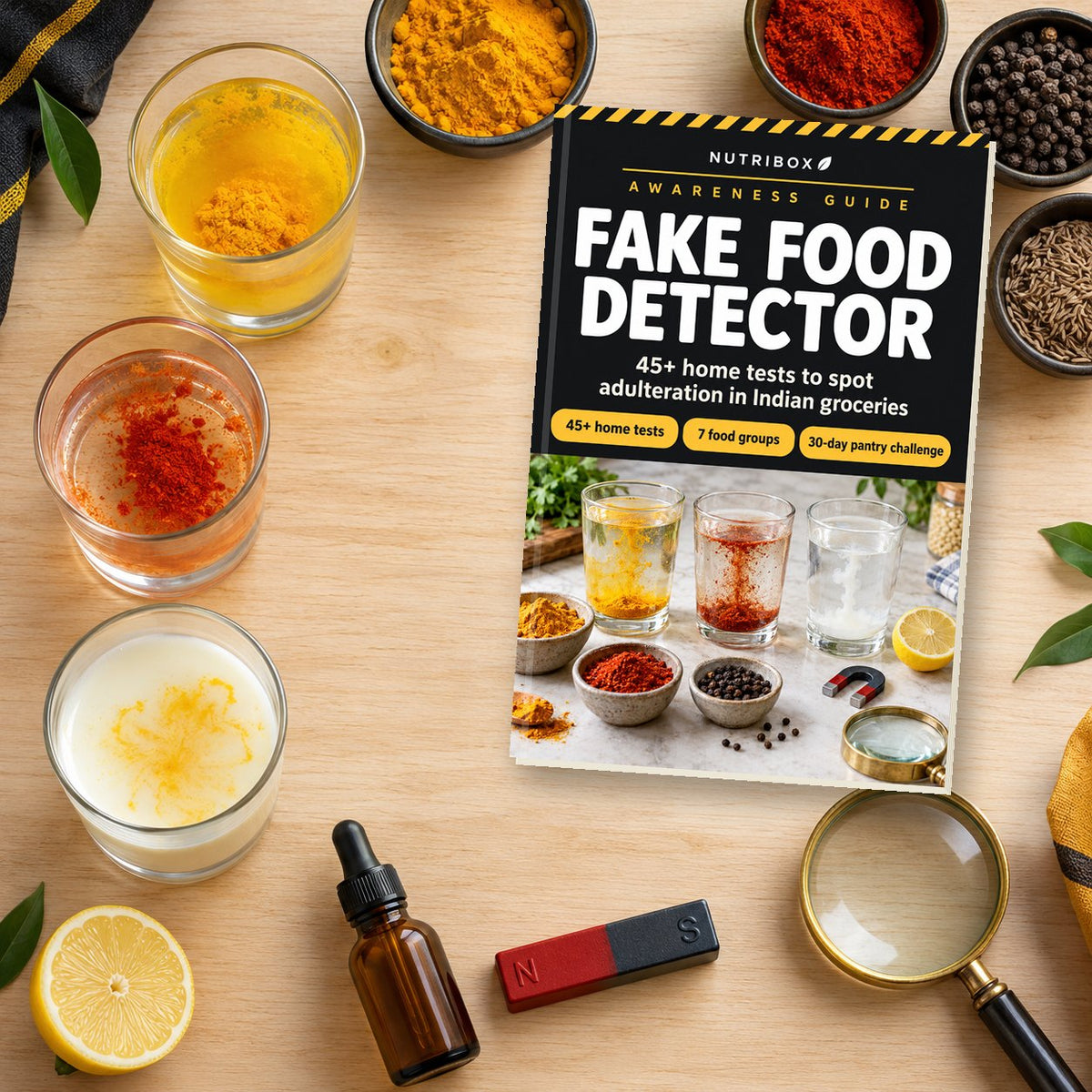
Health Awareness GuideFake Food Detector45+ home tests like this for milk, spices, oil, honey, dal, fruit and tea.
See the guide →
02
Read any food label in 5 seconds
The front of the pack is advertising. The real story is on the back.
How to do it
- Ingredients are listed from most to least, so the first two or three tell you what you are really buying.
- Look for sugar under other names: glucose syrup, invert syrup, maltodextrin, dextrose and fructose.
- Compare sugar per 100 g between brands, not per serving, because serving sizes differ.
- 'Multigrain' or 'made with whole wheat' doesn't mean mostly whole grain. Check where atta or maida sits in the list.

Health Awareness GuidePackaged Food Label DecoderHidden sugar names, INS additive codes and an aisle-by-aisle shopping guide.
See the guide →
03
Know when to throw away frying oil
Reusing oil again and again is common in Indian kitchens, but oil breaks down every time it is heated.
How to do it
- FSSAI advises not to reuse cooking oil more than about three times.
- Strain used oil, store it in a closed container and use it up soon for everyday cooking rather than more frying.
- Throw it away if it turns dark and thick, foams a lot, smells strong or smokes at normal frying heat.
- Don't top up old oil with fresh oil to stretch it.

Health Awareness GuideKitchen DangersOil, cookware, plastic, gas and fridge safety, with simple fixes.
See the guide →
04
Follow the 2-hour rule for leftovers
A lot of food poisoning at home starts with cooked food left out for too long.
How to do it
- Cool cooked food and put it in the fridge within 2 hours of cooking.
- Spread big pots of dal or rice into smaller, shallow boxes so they cool faster.
- Reheat leftovers until they are steaming hot all the way through, and reheat cooked rice only once.
- Eat fridge leftovers within a day or two, and keep the fridge at 5°C or colder.

Health Awareness GuideSafe Food StorageA fridge plan, leftover rules for 15 Indian dishes and pantry storage tips.
See the guide →
05
Do the 10-second street food check
You don't have to give up chaat. You just need to pick the stall wisely.
How to do it
- Choose busy stalls where food is cooked fresh and sold fast.
- Food should be served hot. Skip cut fruit and salads that have been sitting uncovered.
- Watch the hands: the person serving food shouldn't also be handling money without washing.
- Be careful with ice and pani puri water on hot days, and ask where the water comes from.

Health Awareness GuideStreet Food SafetyVendor checks, water and ice rules, and what to do if food poisoning strikes.
See the guide →
06
Pick desi foods over costly imports
You don't need expensive imported 'superfoods' to eat well. Your local market already has them.
How to do it
- Amla and guava are rich sources of vitamin C.
- Ragi and til (sesame) bring calcium, and alsi (flax) seeds bring plant omega-3 fats.
- Chana, rajma, moong, peanuts and curd give you everyday protein.
- Seasonal local fruit and vegetables are usually fresher and cheaper than packaged 'super' products.

Health Awareness GuideSuperfood MythsImported fads vs desi champions, detox myths and a seasonal food calendar.
See the guide →
07
Know what really supports your immune system
No single drink, kadha or pill 'boosts' immunity overnight. Everyday habits do the real work.
How to do it
- Adults need 7 to 9 hours of sleep. Short sleep is linked to catching infections more easily.
- Eat enough protein, fruit and vegetables, and keep up with the vaccinations your doctor advises.
- Wash hands with soap before eating and after using the toilet.
- Check the label on 'immunity' drinks and powders: many contain a lot of added sugar.

Health Awareness GuideImmunity: Myths vs FactsWhat kadha, supplements and 'immunity' products can and can't do.
See the guide →
08
Stop putting toothpaste on burns
Toothpaste, ghee or ice on a burn can make it worse. Here is what to do instead.
How to do it
- Hold a small burn under cool running tap water for about 20 minutes.
- Take off rings or tight items near the burn before it swells.
- Cover it loosely with a clean cloth or cling film, and don't burst blisters.
- Get medical help for large, deep or facial burns, burns on a child, or burns from chemicals or electricity.

Health Awareness GuideHome Remedies: What Works?Popular nuskhe rated by evidence, risky ones to stop, and red-flag symptoms.
See the guide →
09
Make small swaps for maida and sugar
Small swaps add up when the whole family eats them every day.
How to do it
- Use whole wheat atta, or half atta and half maida, for parathas, cakes and pooris.
- Gur, honey and brown sugar are still sugar, so keep them small too.
- Give whole fruit instead of packaged fruit juice.
- Check 'digestive' and 'marie' biscuit labels: many are still mostly maida and sugar.

Health Awareness GuideThe Maida and Sugar TrapWhere maida and sugar hide, plus an Indian swap book for the whole family.
See the guide →
10
Build a fuller, lighter Indian plate
You can keep roti and rice on the plate and still eat lighter.
How to do it
- Fill half the plate with sabzi or salad.
- Make a quarter of the plate protein: dal, paneer, curd, chana or rajma.
- Keep the last quarter for roti or rice.
- Watch the hidden extras: oil in the tadka and sugar in chai add up over a day.

Health Awareness GuideHealthy Weight Without DietingThe Indian plate makeover, hidden calories and a 30-day challenge.
See the guide →
11
Make soft millet rotis that don't crack
Most families give up on millets because the rotis break. A few small changes fix that.
How to do it
- Knead jowar or bajra flour with hot water, a little at a time.
- Knead small portions just before rolling, because millet dough dries quickly.
- Pat the roti by hand, or roll it between two sheets of parchment or plastic.
- Just starting? Mix millet flour with wheat atta and add more millet slowly.

Health Awareness GuideMillets Made SimpleAll 9 millets explained, soaking and water ratios, and soft roti secrets.
See the guide →
12
Add protein to every vegetarian meal
Many Indian vegetarian meals are heavy on roti and rice and light on protein.
How to do it
- ICMR-NIN suggests about 0.8 g of protein per kg of body weight a day for most healthy adults.
- Add a bowl of dal, curd, paneer, chana, rajma or sprouts to every main meal.
- Keep peanuts, roasted chana or soya chunks for snacks.
- Dal with rice or roti is a good pair: together they give a better mix of protein building blocks.

Health Awareness GuideProtein for Indian VegetariansA protein A to Z of Indian vegetarian foods and a budget protein plan.
See the guide →
13
Test for four common gaps
Many Indian families are low in vitamin B12, vitamin D, iron or calcium without knowing it.
How to do it
- Vitamin B12 comes mainly from animal foods, so vegetarians often get less. Milk, curd and paneer help.
- Living in a sunny country doesn't guarantee enough vitamin D, especially if you're indoors all day.
- Tiredness, tingling in hands and feet, or hair fall can have many causes, including these gaps.
- Get a blood test and talk to your doctor before starting any supplement.

Health Awareness GuideVitamins and Deficiencies in IndiaEarly signs, how to read your blood reports, and food-first fixes.
See the guide →
About the Health Awareness Guides
Each guide is a full-colour soft copy PDF of 160 to 176 pages, with simple pictures, checklists, a 30-day challenge and printable charts. The download link arrives by email right after payment, and the PDF opens on any phone, tablet or laptop.
Pick the topic that matters most to your family, or read them all. Browse all 13 Health Awareness Guides →


 Goal Bundle
7 Healthy Recipe Bundles by Goal: Which One Suits Your Family?Read the recipes →
 Living With a Health Condition: Daily Food and Habit Tips for 9 ConditionsRead the recipes →
 9 Common Health Risks in India and Everyday Habits That Lower ThemRead the recipes →
 Summer Special
22 Healthy Indian Summer Recipes to Beat the HeatRead the recipes →
 Winter Special
22 Healthy Indian Winter Recipes for Cold DaysRead the recipes →
 Dinner
22 Healthy Indian Dinner Recipes for Busy WeeknightsRead the recipes →
 Protein for Indian Vegetarians
 Vitamins and Deficiencies in India
 Millets Made Simple
 Healthy Weight Without Dieting
 The Maida and Sugar Trap
 Superfood Myths
 Immunity: Myths vs Facts
 Home Remedies: What Works?
 Safe Food Storage
 Street Food Safety
 Packaged Food Label Decoder
 Kitchen Dangers
 Fake Food Detector


