We've sent you an email with a link to update your password.
Reset your password
We will send you an email to reset your password.
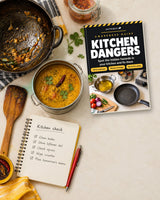
Nutribox Awareness Guide
Kitchen Dangers
Reused oil, scratched pans, plastic tubs, leftovers and gas leaks: spot the hidden hazards in an Indian kitchen and fix them with simple, everyday science.
Most kitchen risks are small daily habits. That makes them easy to fix.
100M+
episodes of foodborne illness happen in India every year.
Source: WHO South-East Asia foodborne disease estimates
362+
species of bacteria have been found living in used kitchen sponges.
Source: Scientific Reports kitchen sponge study
25%
polar compounds is the legal limit before frying oil counts as unsafe.
Source: FSSAI RUCO regulation
Test yourself
Safe or risky?
Tap the safer choice in each pair. Then see why.
Which oil is safe to cook with?
Dark, foamy, smoky oil has broken down. The book lists 4 signs it's time to throw oil away.4 signs to discard oil · page 28
Which chopping board is better?
Deeply scratched plastic boards can shed microplastics into food.Chopping boards & microplastics · page 61
Which leftover rice is safer?
Rice left out for hours can grow bacteria that make toxins. Cool it fast and refrigerate.The 'fried rice syndrome' · page 116
Which pan should you keep?
A heavily scratched, peeling non-stick pan is due for replacement.Non-stick safe thresholds · page 43
Inside the book
Every corner of the kitchen
Pick an area to see a few of the fixes inside.
Reusing frying oil again and again
The riskOil breaks down with every reheat
The fixDiscard dark, foamy or smoky oil
Oil smoking in the pan
The riskToo hot for that oil
The fixUse the smoke-point chart
Free-pouring oil
The riskEasy to use far too much
The fixMeasure with a spoon
The book covers each area in detail, with charts and checklists.
Scratched non-stick pans
The riskDamaged coating
The fixReplace; cook on low-medium heat
Tamarind or tomato in aluminium
The riskSour food reacts with the metal
The fixUse steel, clay or seasoned iron
Unlined copper or brass
The riskMetal can leach into sour food
The fixUse tin-lined (kalai) vessels
The book covers each area in detail, with charts and checklists.
Heating food in plastic tubs
The riskHeat can leach chemicals
The fixUse glass or ceramic
Old, scratched chopping board
The riskSheds microplastics
The fixSwitch to wood or replace often
Hot food in thin plastic bags
The riskHeat plus plastic contact
The fixUse steel dabbas
The book covers each area in detail, with charts and checklists.
Cooked rice left out overnight
The riskBacteria can make toxins
The fixCool quickly, then refrigerate
Food kept in the danger zone
The riskGerms grow fast at 5°C to 60°C
The fixKeep it cold or piping hot
The kitchen sponge
The riskHundreds of bacteria species
The fixDry it daily, replace often
The book covers each area in detail, with charts and checklists.
You smell gas
The riskLeak and fire risk
The fixDon't touch switches; open windows; call 1906
Oil catches fire in a kadai
The riskWater makes it flare up
The fixTurn off the gas and cover with a lid
Mixing cleaners
The riskCan release toxic gas
The fixNever mix bleach with acid cleaners
The book covers each area in detail, with charts and checklists.
Keep these handy
Your kitchen safety kit
Small, cheap things that prevent most kitchen accidents.
🌡️
A fridge thermometerKeep it at 5°C or below
🥘
A tight-fitting lidTo smother an oil fire
🪵
A wooden chopping boardFewer microplastics
🥫
Steel dabbasInstead of hot food in plastic
🥄
A measuring spoonFor oil and ghee
11 parts
Everything in one book
01
The Invisible Risk14 pages · 4 topics
02
The Oil Trap16 pages · 5 topics
03
Cookware Decoded16 pages · 4 topics
04
Plastic in the Pantry16 pages · 4 topics
05
The Fake Food Detector24 pages · 6 topics
06
Washing Produce & Pesticides16 pages · 4 topics
07
Bacteria & Food Spoilage16 pages · 4 topics
08
Flame, Gas & Chemical Hazards16 pages · 4 topics
09
Kitchen Myths vs Science10 pages · 2 topics
10
The 30-Day Kitchen Safety Challenge10 pages · 4 topics
11
The Kitchen Safety Toolkit8 pages · 4 topics
Look inside
Real pages from the book
Swipe → · Tap any page to zoom
Kitchen safety auditFood safety in numbers4 signs to discard oilCookware safety spectrumPlastic codes decodedWashing produce the right wayThe danger zoneFridge shelf planGas leak protocolCookware myths30-day challengeFridge temperature chart
Every topic inside
Open the guide, see every chapter
11 parts · 45 topics · Tap a part to see what's inside
01The Invisible Risk14 pages · 4 topics
India's Food Safety Burden in Numbers
Where Hazards Hide in Your Kitchen
The Kitchen Hazard Matrix
5 Emergency Incidents to Rehearse
02The Oil Trap16 pages · 5 topics
What Happens When Oil Reheats
The 25% TPC Safety Limit
4 Sensory Signs to Discard Oil
Deep-Frying Temperature & Safety Rules
Cooking Oil Upgrades & Swaps
03Cookware Decoded16 pages · 4 topics
Cookware Safety Spectrum
Non-Stick Safe Thresholds vs Overheating
Acidic Dishes & Metal Reactivity
Cookware Upgrades & Material Swaps
04Plastic in the Pantry16 pages · 4 topics
Plastic Resin Codes 1 to 7 Decoded
The Code 5 Polypropylene Myth
Plastic Chopping Boards & Microplastics
Safe Microwave Reheating Protocol
05The Fake Food Detector24 pages · 6 topics
FSSAI DART Home Screening Principles
Testing Milk & Dairy Products
Testing Cooking Fats & Ghee
Testing Turmeric & Powdered Spices
Building Your Home Testing Kit
Reporting Adulteration to FSSAI
06Washing Produce & Pesticides16 pages · 4 topics
Pesticide Hotspots in Market Produce
The ICMR-NIN 2024 Washing Protocol
Naturally Ripened vs Carbide Fruit
The 10-Minute Produce Receiving Routine
07Bacteria & Food Spoilage16 pages · 4 topics
The 5°C to 60°C Danger Zone
The 'Fried Rice Syndrome' Explained
Refrigerator Shelving Architecture
The Kitchen Dish Sponge Hazard
08Flame, Gas & Chemical Hazards16 pages · 4 topics
📧 Download link sent to your email right after payment
📴 Read offline, no internet needed
🖨️ Print the charts at home, for personal use only
♾️ Lifetime access, no subscription
📱 Read on any device: mobile, tablet, laptop
📖 No hard copy will be dispatched
🎁 A great housewarming or new-kitchen gift.
Your questions, answered
Do I need to replace all my cookware?
No. The book helps you check what you have, fix simple habits, and replace only what's truly worn out.
Is this only about food?
No. It also covers gas leaks, oil fires, cleaning chemicals and emergency steps for the whole family.
Is this meant to scare me?
Not at all. Most kitchen risks are small daily habits with easy, cheap fixes.
How will I get the book?
It's a PDF. After payment you get a download link by email. Read it on your phone, tablet or laptop, and print the charts if you like.
Is there a printed copy?
The printed hard copy is out of stock right now. The PDF is available instantly.
Digital product (PDF soft copy only). For education and awareness only. In any gas, fire or medical emergency, call the emergency services. Figures are quoted from sources cited in the book. Images are illustrative.




 Vitamins and Deficiencies in India
 Protein for Indian Vegetarians
 Millets Made Simple
 Healthy Weight Without Dieting
 The Maida and Sugar Trap
 Superfood Myths
 Immunity: Myths vs Facts
 Home Remedies: What Works?
 Safe Food Storage
 Street Food Safety
 Packaged Food Label Decoder
 Kitchen Dangers
 Fake Food Detector


